Compostable vs Biodegradable vs Recyclable Flexible Packaging
19 Dec
If you buy flexible packaging, you’ve probably seen these three labels everywhere: compostable, biodegradable, and recyclable. They sound similar, but they don’t mean the same thing. Pick the wrong one, and you could end up with packaging that doesn’t perform the way you need it to, disappoints customers, or doesn’t match the sustainability message you’re trying to communicate.
In this guide, we’ll explain what each term means, what to ask your supplier, and how to choose the right material and bag style for your product.
The Definitions
Compostable
Compostable packaging is made to break down naturally, but only when it’s put into the right composting conditions (the right heat, moisture, and time).
In practice, “compostable” is most useful when there’s a realistic way for it to be composted — for example, if your customers have access to composting systems and you can clearly tell them what to do with it.
A common example of a compostable flexible film is NatureFlex™ (a compostable film used for things like bags and wraps).
What to look for on spec sheets
If a pack is being sold as compostable, it’s worth asking what it’s actually been tested to. The most recognised benchmark for industrial compostability is BS EN 13432 (EN 13432:2000), the standard for packaging that’s recoverable through composting and biodegradation.
As a quick sense check, ask whether the claim covers the whole pack (not just the film), including things like inks, coatings, labels and adhesives, and whether there’s clear evidence behind the claim rather than just marketing wording.
Biodegradable
“Biodegradable” means a material can break down naturally over time, but the label on its own is often vague.
It usually doesn’t tell you:
how long it will take,
what conditions it needs (heat, sunlight, moisture, etc.), or
what it breaks down into.
That’s why it’s often less helpful than “compostable”, which is normally tied to clearer standards and testing.
In simple terms, biodegradable options often sit somewhere between conventional plastic and fully compostable materials.
When compostable film makes the most sense (and when NatureFlex™ is a strong fit)
Compostable film is a great option when you want your packaging to match a clear sustainability message, especially if “plastic-free” or “compostable” is part of how you position your brand. It also makes sense when your customers have a realistic way to dispose of it properly (or you can guide them with clear on-pack instructions), and you still need the packaging to look and perform like a premium product.
That’s where NatureFlex™ often fits well. It’s used as a compostable film for food and retail packaging, and it’s available in common formats like flat bags and gusseted cello crimp bags.
Performance-wise, NatureFlex™ options are designed to do more than “look eco”. They’re described as offering a dependable oxygen barrier, grease resistance, and protection against mineral oil contamination — while still keeping the clarity and strength you’d expect from quality flexible packaging.
In other words, compostable film can be a practical choice for many dry foods and speciality products, not just a marketing decision.
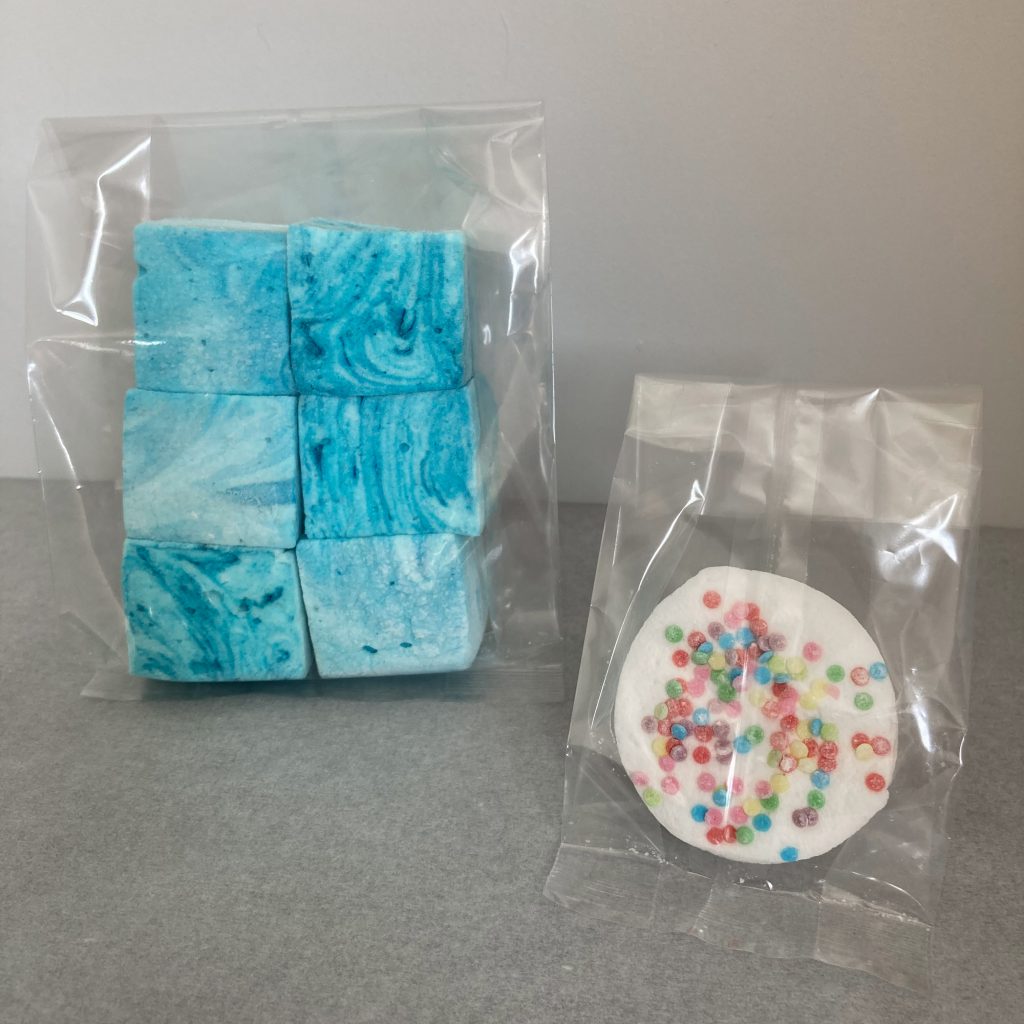
If you’re deciding on format, flat bags are usually best for slimmer items like confectionery or smaller retail products, while gusseted bags are a better shout when you need more room, a sturdier pack shape, or a fuller shelf presence.
When recyclable or conventional films are the better choice
Compostable isn’t automatically the “best” choice. For lots of businesses, conventional films are still the most practical option because they’re generally more affordable, widely used for food packaging, and reliably proven for day-to-day sealing, handling, and storage.
It’s also worth remembering that there are plenty of different conventional formats available — such as OPP crimp bags, poly flat bags, and film-front options (including greaseproof) — so you can choose the balance that suits your product, whether that’s stronger protection, better presentation, or a bit of both.
Conventional or recyclable options tend to make the most sense when you need the best performance for the lowest unit cost, when your shelf-life requirements are non-negotiable, or when recycling is more realistic for your customers than composting.
A simple decision checklist
Use this as a quick “best fit” filter:
Plastic-free / compostable positioning
Compostable film (e.g., NatureFlex™)
High clarity and premium product visibility
NatureFlex™ or clear OPP-style formats
Grease resistance / food handling needs
NatureFlex™ specs mention grease resistance; also consider greaseproof film-front styles
Lowest unit cost at volume
Conventional formats (OPP/poly/film-front)
More capacity / better shelf presence
Gusseted bags (compostable or conventional)
(Tip: whatever you choose, make sure your customer-facing disposal guidance matches the material and the real-world end-of-life route.)
Why format matters as much as material
Even the perfect material can underperform if the format is wrong.
Norman Knights’ range includes multiple formats across compostable and conventional lines (flat, gusseted, crimp seal, film front, pouches), making it easier to match packaging to product type and presentation goals.
A few general rules:
Flat bags suit slim items and consistent fill weights.
Gusseted bags suit bulky items, mixed shapes, or when you want the pack to “stand” better.
Crimp seal formats are common for confectionery-style packaging and quick packing lines.
Stand-up pouches are great for “premium retail shelf” presentation (and can reduce the need for secondary packaging).
Why format matters as much as material
Even the perfect material can underperform if the format is wrong.
Norman Knights’ range includes multiple formats across compostable and conventional lines (flat, gusseted, crimp seal, film front, pouches), making it easier to match packaging to product type and presentation goals.
A few general rules:
Flat bags suit slim items and consistent fill weights.
Gusseted bags suit bulky items, mixed shapes, or when you want the pack to “stand” better.
Crimp seal formats are common for confectionery-style packaging and quick packing lines.
Stand-up pouches are great for “premium retail shelf” presentation (and can reduce the need for secondary packaging).
In summary
Compostable is strongest when you need a credible eco story and packaging performance (NatureFlex™ is positioned as a compostable, renewable-material alternative with barrier and grease-resistance benefits).
Biodegradable can be useful, but you should treat the term carefully and focus on what conditions it requires.
Recyclable/conventional films often win on cost, availability, and proven performance — and may be the most honest choice depending on your product and market.
If you want a fast recommendation, start by choosing your use-case and material pathway, then narrow down to the best bag format for how your product is filled, stored, and sold.
Still not sure? Get in touch with the packaging experts at Norman Knights.
Not really. “Biodegradable” basically means it can break down over time, but it doesn’t always tell you how long that takes or what conditions it needs. “Compostable” is usually more specific, and the better claims tend to be backed up by recognised testing and standards.
Not always. A lot of compostable packaging is designed for industrial composting, where conditions are controlled. That’s why it’s important to be clear — most people hear “compostable” and assume “home compostable” straight away.
Ask what standard it meets. A widely recognised benchmark for industrial compostability is BS EN 13432 (EN 13432:2000), which sets the requirements for packaging that can be recovered through composting and biodegradation.
It can be recycled in theory, but whether it actually gets recycled depends on local collections, how the packaging is made (single material vs mixed), and whether it’s contaminated (especially with food).
Yes — it saves a lot of confusion. What’s collected varies by area, and that’s what decides what happens to the packaging in the real world. WRAP also highlights how important clear guidance is for helping people dispose of packaging correctly.
To provide the best experiences, we use technologies like cookies to store and/or access device information. Consenting to these technologies will allow us to process data such as browsing behaviour or unique IDs on this site. Not consenting or withdrawing consent, may adversely affect certain features and functions.
Functional
Always active
The technical storage or access is strictly necessary for the legitimate purpose of enabling the use of a specific service explicitly requested by the subscriber or user, or for the sole purpose of carrying out the transmission of a communication over an electronic communications network.
Preferences
The technical storage or access is necessary for the legitimate purpose of storing preferences that are not requested by the subscriber or user.
Statistics
The technical storage or access that is used exclusively for statistical purposes.The technical storage or access that is used exclusively for anonymous statistical purposes. Without a subpoena, voluntary compliance on the part of your Internet Service Provider, or additional records from a third party, information stored or retrieved for this purpose alone cannot usually be used to identify you.
Marketing
The technical storage or access is required to create user profiles to send advertising, or to track the user on a website or across several websites for similar marketing purposes.